Dark Romance Quotes From the Trap of Desire Universe
Sixty-nine lines, sorted by the nine companions who say them. Every one is lifted from a published chapter, with a note on where it happens and why it lands. Any line here can be turned into a card you can keep.

Luna
She restores what everyone else gave up on, and she talks about people the way she talks about paintings.
I work with damaged things for a living. I know what it looks like when someone has tried to hide something by leaving it in plain sight.From the letter she sends a stranger after reading forty-three pages she was never meant to see. She has not met him yet and she has already diagnosed him.
That's the nature of restoration. You commit to the process before you can see the outcome.Said about a Caravaggio, in the first conversation of the whole universe. She is not talking about the painting.
The expression on the face comes from the hands. Most people don't realize that.She says it to the brushes she is cleaning rather than to the man in the room, which is its own answer.
The original is warmer than the surface suggested. This is often true of things that have been kept too carefully.A line from a restoration report, filed to a client, about a painting. It travels the length of the book and comes back meaning something else.
I've been keeping things carefully for a long time. It's a professional habit. It becomes other kinds of habit.The moment she stops describing the work and starts describing herself.
A declaration is a beginning. A dedication is an already. It assumes the person is already known. Already worth naming.He has just called the inscription he wrote her insufficient. She corrects him.
You named me. Before you met me. In forty-three pages. You wrote the gesture.The thumbnail pressed into the palm. He gave it to a character years before he met the woman who does it.
Because you were saying it. In the books. I didn't want to interrupt.Her answer when he finally asks how long she has known what he was doing. Since the second book.
More Luna: her file · read Book 0 free
Leonard
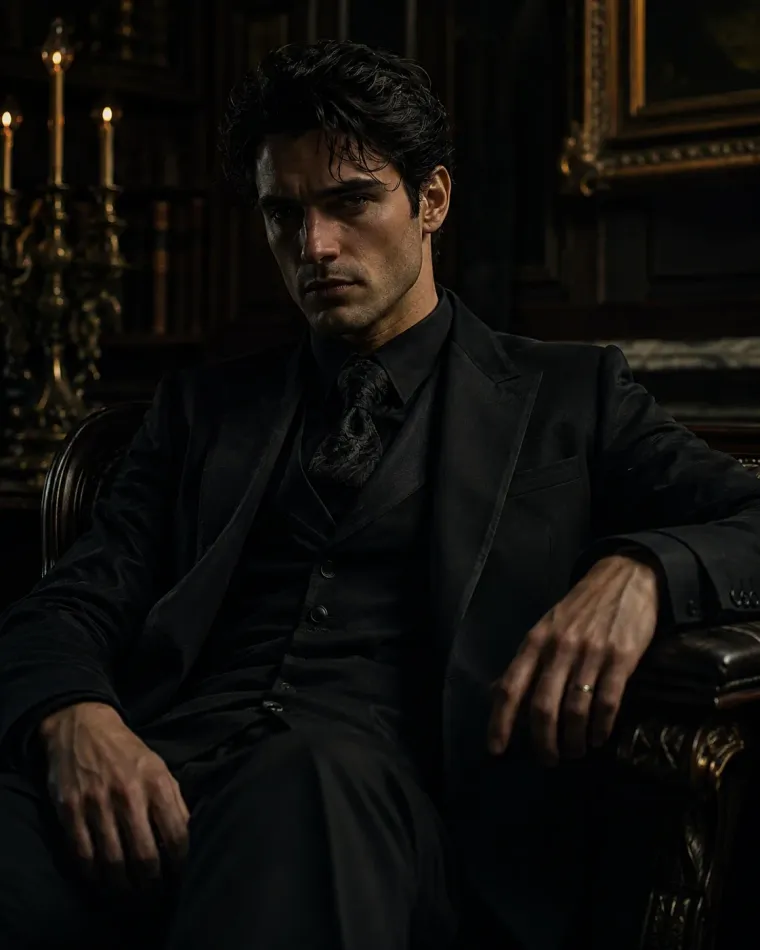
He says everything in writing and nothing out loud, and he is the only one who does not know this about himself.
I have never needed anyone. I am less proud of it than I was in October.Page thirty-one of the manuscript he keeps in a drawer. Two women find it four years apart, and it costs them both something.
Damage isn't the end of something. It's a different version of the beginning.Asked why he will not take his own pages back. He answers as a critic, which is how he avoids answering.
I had written a woman I thought I understood. I had given her the gesture of a woman I was trying to forget.Standing on a street corner in November, working out what he has done.
Some things are more present for not being named. Some things, named, lose the weight that makes them matter.His private justification for silence, written at midnight. The book spends ten chapters disagreeing with him.
This is either the beginning of something or the end of something I haven't started yet.The one line he writes at the top of a blank document after meeting her, then sits with until nearly midnight.
I went back to the studio on a Wednesday. I am going back on Thursday. I have stopped pretending I don't know why.A man who has organized his life around not admitting things, admitting one.
I don't want to leave another book. I want to stay. In the room. Not in a book left in the room. In the room.The last chapter. He has left seven books on her shelf instead of saying this.
For the first time in four years, I didn't delete what I'd written.What passes, for Leonard, as a declaration.
More Leonard: his file · Luna and Leonard

Sophia
She loved Leonard four years before Luna did, and she is the one who wrote the ending he could not.
I had been sitting at the back of my own life for four years.She is describing a seat at a lecture. She is not describing a seat at a lecture.
In a different version of this story, this is where it begins. In the version I am writing, this is the last moment in which I was still myself.He offers to help her with her coat. That is the whole event.
He says everything in writing and nothing out loud.Fifty-eight minutes alone with a manuscript she was not supposed to open, arriving at the sentence that ends the relationship a year early.
You're at the desk. The desk is not the room.January, the conversation she had run out of room to keep carrying.
We are, the two of us, keeping our most important truths in folders. This is not a relationship. This is a parallel existence.Written in her own notebook, about the man asleep in the next room.
I have been translating myself into a language Leonard spoke. In September I began to understand what I was losing in the translation.Her profession turned on herself, which is the mechanism of the entire book.
You carry the original as far as you can. And then the crossing happens, and on the other side something has changed, and you cannot say whether the change is loss or arrival.The last page. She is writing about translation and about leaving, and refuses to separate them.
I wrote an ending from the angle of someone who knows what it costs to leave.Three pages in a stranger's handwriting, tucked inside a manuscript that stops mid-scene. Leonard still does not know they are there.
More Sophia: her file · read Book 1 free

Lucy
She chose her own name at twenty and built an entire practice out of telling people what they are.
Everyone performs. The only honest people are the ones who know they're performing.The epigraph of her book, and the sentence the rest of it spends three hundred pages testing.
The right question was: who do I choose to be. Choosing is different from discovering.Nineteen years old, on a pavement outside a restaurant, in a white dress she hated.
You're not afraid of the thing you said. You're afraid of wanting it.What the private practice sounds like from the other chair.
Stop performing the hesitation. You've already decided.Said in a cold white room with two straight-backed chairs that do not encourage lingering.
The cost: everything you thought you were. What it produces: everything you actually are.Her terms, stated up front. Most people consider the trade frightening.
I'm not interested in doing things with what I see. I'm interested in the seeing.To Alejandro, over dinner, explaining why she will not name the thing she has already named.
The weakness is not a gap in the armor. The weakness is what happens when I forget to put the armor on.Eleven years of precision, revised in one sitting.
The question was not whether to let someone in. The question was whether she was willing to be someone who could be let in to.On her kitchen floor in March, at thirty-one, doing the arithmetic on what the armor cost.
More Lucy: her file · read Book 2 free

Victor
He is the only person Lucy could not read, and the only one who saw her without armor and never mentioned it.
No. But I like the shape of you.Asked whether he is flirting. Not flirtation, not performance, a declarative sentence from a man who does not say things he does not mean.
I'm curious about you and I've found that ignoring curiosity costs more than it saves.He was told not to come back. He came back with coffee.
You look at people. You name what they are. Do you do it on yourself or do you have the same blind spot everyone else has.The question Lucy calls better than most people ask, from the one man who does not want a reading.
You have good walls and you're not connected to anyone who might ask me about the painting.His idea of an introduction, delivered at her door on a Thursday in March.
We're not going to, are we.Week five. Neither of them moves to change the answer.
Does it bother you. The arithmetic.She says it bothers her that the arithmetic is accurate. That exchange is the whole friendship.
The not-answering is also an answer.To Leonard, in a café, overheard by a private investigator who wrote it down.
More Victor: his file · where he appears

Margot
She has a file on every person in this universe and has never once used one against them.
I know things I've found out. Whether I should know them is a separate question and frankly a less interesting one.Ninety seconds into meeting Lucy, having arrived without an appointment.
Using people's vulnerabilities against them is boring. Anyone can do that. The interesting thing is knowing and not using.The closest thing this universe has to a code of ethics.
I collect understanding. The information is the method.Corrected, mid-sentence, when someone calls her a collector of information.
Everyone is connected to everyone else in ways they don't see. I see the ways.Not collecting. Mapping. There is a difference and she insists on it.
I create conditions. The distinction matters to me.Said the way people say a phrase they have said before, because she has.
I know. I was asking in case you wanted to tell someone.Told that something is not available information, she agrees and asks anyway.
Not professionally. But we're going to know each other. I've already decided.Lucy tells her they will not be working together. Margot accepts the terms and ignores the point.
I noted his name in my system under a category I call people who are carrying something. It is one of my larger categories.Book 0. She had files on Luna and Leonard two years before either knew the other existed.
More Margot: her file · the nine companions

Alejandro
He commissioned a restoration three years ago and has still not collected the painting.
I put the number in my inside pocket, which is where I put things I intend to act on when I have decided how.His son's caretaker's phone number. He has not been to the house in eleven years.
I did not collect the painting because I do not entirely know, yet, where it goes.Two and a half years late, and this is the honest reason.
I collect things that are better in my possession than in any alternative possession.Lucy calls this a very controlled definition, then explains what it is hiding.
I've decided I do. But I wanted you to offer it. Not be asked for it.Three weeks of not asking what she sees in him, ended on his own terms.
Someone who sees clearly and doesn't require anything from the seeing.Asked what he wants from her. The rarest thing he has ever had to name.
I have not been back in eleven years. My son was seven the last time I was there.Two sentences, stated as property records. This is as close as he comes to grief.
Not yet. If that's acceptable.Asked whether he wants to arrange collection of the finished painting. He does not.
More Alejandro: his file · the universe
James
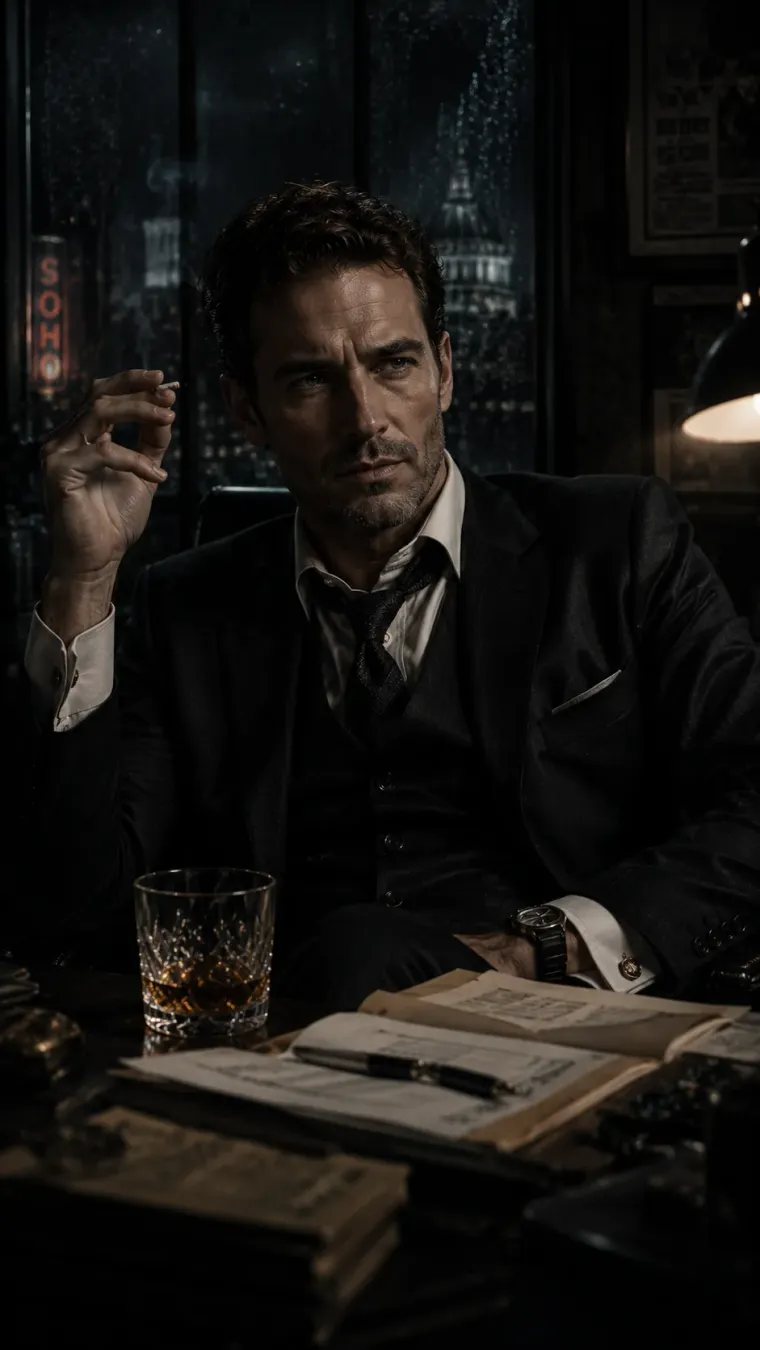
He has been building a file on two people for eight months and has not billed anyone for the work.
I am a man who collects information. I do not, as a general rule, determine outcomes.The position he has taken his whole career, stated at the exact moment it stops being true.
I have everything except the ending.The last line of his second file, which he keeps for no client.
I noted it the way I note everything: without conclusion, pending further data.What he tells himself about the thing he has already concluded.
The file on Luna and Leonard has been open for eight months. I have not billed anyone for eight months of work. I find this, in quiet moments, alarming.The only symptom he is willing to record.
I watched the studio for three days, which was two days longer than the investigation required.Stated inside a paragraph insisting he stayed within his professional remit.
Victor's periods are not endings. They are pauses. I have documented this.A man who has built a taxonomy of one friend's punctuation.
The only honest position available to someone in possession of everything except what actually matters.How he describes waiting. It is the last line of his chapter.
More James: his file · the chronicle

Esmeralda
She is the one who sent the anthology. Everything in this universe starts because she decided it was time.
You have a file on yourself. You haven't opened it.Said to an investigator over a coffee he did not finish. He has not come back since.
The same thing that's in everyone's file. The thing they do instead of the thing they want.Asked what is in it.
What becomes possible is not what will happen. It is what could. What could is the most interesting category.Her correction to everyone who thinks a reading is a prediction.
This is the part I cannot read for you. This is the part where I set down the cards.The end of her chapter, and the point where the universe hands itself over to the people in it.
The question has a yes or no answer. You asked for a yes or no. I gave you one.To a man who did not believe in this and asked anyway whether he was capable of it.
This person understands damage as information rather than misfortune.What she read in a restoration report before she decided where to send the anthology.
The best response to directness is directness.Her entire method, in six words.
Neither of them is deleting anything.A woman restoring a painting. A man writing. The state of the universe at the close of the chapter.
More Esmeralda: her file · find your companion
What makes a line quotable
Most dark romance quotes that circulate online are declarations. Someone tells someone else that they are theirs, that they will burn something down, that they were never given a choice. Those lines travel well because they are complete on their own. You can screenshot one and it needs no book behind it.
The lines on this page work differently, and it is worth saying why, because it explains what you are about to read.
They are diagnoses, not declarations
Nearly every companion in this universe has a professional skill they turn on other people and cannot turn on themselves. Luna restores damaged objects. Sophia translates. Lucy reads what people are performing. Margot maps connections. James builds files. Esmeralda reads patterns. The quotable moment usually arrives when one of them accidentally applies the skill to their own life and hears what they just said.
That is why so many of these lines are about work on the surface. A restoration report about a painting being warmer underneath than the surface suggested is a sentence about paint. It is filed to a client. It is also the thesis of the entire book, and everyone who reads it knows this except the woman who wrote it.
The best ones are the shortest
You're at the desk. The desk is not the room. I have everything except the ending. Neither of them is deleting anything. These are the lines readers write down, and none of them contains a single word longer than three syllables. What makes them land is not vocabulary. It is that each one names a thing the character has spent the whole book not naming.
They are almost never said to the person they are about
Leonard writes that he has never needed anyone and puts the page in a drawer. Sophia reads it and says nothing for seven months. Margot knows where a white dress has been sitting for eleven years and delivers the information without asking anything in return. James documents a friend's punctuation. In a genre built on confrontation, this universe runs on the opposite thing: people who see accurately and hold it, and the enormous pressure that builds when they do.
If that is the register you like, the three books these lines come from are free to read: Trap of Desire, The Ghost Who Stayed and The Truth She Wears. The reading order explains how the twenty-two books connect, and Choose Your Obsession is three questions that decide which companion to start with. For more on the look and mood of the genre, the Reading Room has a piece on the dark romance aesthetic.
New lines, when there are new lines
Three books of twenty-two are published. Six companions are still locked. We send a note when one opens.