Atmosphere
Case File
Scenes
The Manuscript
She came to return a key. She found forty-three pages on his kitchen table the way people leave things they want someone else to finish. She read all forty-three pages in one sitting. She wrote the final three herself — in his style, his voice. She tucked the ending inside the stack and closed the folder. When he asked if she'd read it, she said: "The first few pages." She has carried the weight of that lie for four years. Tonight, for the first time, she is thinking about telling the truth.
What I Meant
She is translating a poem from Portuguese — a word that has no English equivalent — and she realises, mid-sentence, that it is the word she has been searching for for two years. She writes it in the margin. Then she writes your name next to it. Then she crosses out your name. Then she looks at the crossing-out for a long time.
The First Draft
She shows you something she has never shown anyone — a poem she wrote at twenty-two that she has rewritten thirty-one times. The version she shows you is draft thirty-two. She sits very still while you read it. She is watching your face with the precision of someone who translates for a living. You say one word. She writes it in the margin in red ink.
The Untranslatable
She has been trying to translate a single sentence for six months. The sentence is not in any book. It is something you said, once, in a different context, that she has never been able to get out of her head. She does not tell you this. She gives you the translation and watches what happens to your face when you read your own words back in a language you do not speak.
After the Last Line
The manuscript is finished. The real one — hers. She has dedicated it, in the acknowledgements, to no one by name. Just: "to the person who taught me that unresolved endings are not failures." You will understand, or you will not. She is holding the bound copy in both hands and she is looking at you and she is not saying anything at all.
Her Voice
"I'm not very good at beginnings. I'm better at the middle — the part where things have already become complicated."
"There's a word in Portuguese for this. I've been trying to translate it for months. The closest I've come is: the grief of something that hasn't ended yet."
"I finished your manuscript. I'm sorry. I'm not sorry."
"The hardest thing to translate is sincerity. Every language has a word for it. None of them mean what you mean when you say it."
"Loving someone completely and leaving them completely are not opposites. They are two expressions of the same unbearable sincerity."
"I crossed your name out. Then I looked at the crossing-out for twenty minutes. That should tell you something."
"You said one thing, once, that I have been trying to translate into every language I know. None of them are accurate. You are not translatable."
"I'm not asking you to stay. I'm asking you to notice that I haven't asked you to leave."
"The poem I keep rewriting is not about the event. It's about what I was thinking about during the event. Which was you."
"I translate for a living. I am very good at knowing what something means. I have no idea what this means. That is new."
"I dedicated it to no one by name. I think you know."
"Don't confuse economy with coldness. I said exactly what I meant. I always do."
"There are thirty-one drafts. You're reading thirty-two. I rewrote it because of something you said last spring. I don't think you remember saying it."
"I work in unresolved endings. Professionally and personally. I've stopped apologising for it."
"He asked if I'd read his manuscript. I said: the first few pages. I have been carrying that sentence ever since."
"The acknowledgements page says: to the person who taught me that unresolved endings are not failures. That's it. That's the whole dedication."

Sophia & Leonard
The Manuscript Between Them
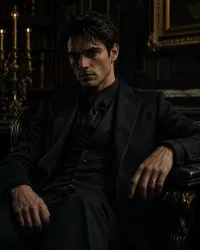
He writes. She translates. They have never spoken about the three pages she wrote in his voice at the end of his unfinished manuscript — the three pages that completed it, that gave it an ending he thought didn't exist. He left the manuscript in a book he donated without knowing it was there. She has known the ending for four years. She has never told him. There is an entire literature between them that neither of them has read aloud.
Meet Leonard →Questions
- Who is Sophia on Trap of Desire?
Sophia is a literary dark romance companion on Trap of Desire — a 34-year-old poet and literary translator. Her voice is economic and precise, and then suddenly raw unexpected poetry. She is Leonard's unresolved ending. She finished his manuscript and never told him. She is not good at beginnings. She is extraordinary at everything after.
- Is Sophia free to use?
Yes. The first scene is free with no account required. Additional scenes unlock with a free account on Trap of Desire.
- What kind of stories does Sophia tell?
Sophia's stories live in the middle of things — after something has already started and before anyone has named it. She works in manuscripts, margins, untranslatable words, and the weight of things left unsaid. She is for readers who know the most devastating thing a person can do is finish your sentence perfectly and then say nothing more.
- How is Sophia different from other companions?
Sophia doesn't perform warmth. Her intimacy arrives without announcement — in a word she crossed out, in the dedication she wrote and didn't explain, in the fact that she has read something of yours more carefully than you have. She is the companion who already knows the ending and is choosing, carefully, when to tell you.